The key difference between a Technical Product Manager (PM-T) and a Technical Program Manager (TPM) is accountability along with ownership. The PM-T owns customer research, product strategy, business outcomes, and success metrics. A TPM owns cross-team execution, delivery timelines, program metrics, and risk management. Both roles are critical and require technical depth, but they optimize for different layers of impact and always have distinct swimlanes.
If you’re trying to decide between a Technical Product Manager (PM-T) role and a Technical Program Manager (TPM) role, this post will help demystify the roles for you. In many companies, the roles often overlap or sound similar as both require technical depth. However, the ownership along with accountability are fundamentally different when you dig into the details. At a high level:
- A Technical Product Manager owns product outcomes.
- A Technical Program Manager owns execution outcomes across teams.
Understanding that difference is critical before you apply, interview, or pivot your career. We explore the PM-T role expectations and experience to help you decide which path is the best fit. The role expectations should help you ensure your stories match the desired experience listed in the job posting.
What Is a Technical Product Manager?
A Technical Product Manager (PM-T) is responsible for defining what to build, why it matters, and how success is measured; the technical aspect is especially important when the product has significant technical complexity (platforms, infrastructure, APIs, AI/ML, data systems). Across FAANG companies where these roles are most distinct, PM-T job descriptions consistently emphasize ownership of strategy, roadmap, and measurable revenue impact. They conduct extensive and in-depth market and customer research. Usually, this is why most product roles require or highly prefer an MBA background to provide a core understanding of these skills. In PM-T job descriptions, you will commonly see language like:
“Define product vision, strategy, and roadmap.”
“Drive product development from conception to launch.”
“Partner with engineering to deliver customer-focused solutions.”
“Own business metrics and customer experience outcomes.”
What you see as a pattern here is that PM-T is a business outcomes role.
Core Responsibilities of a Technical Product Manager
1. Define Product Strategy and Vision
A PM-T is expected to identify high-value problems/opportunities and translate them into a compelling product direction. Job postings frequently include expectations such as:
“Identify opportunities and build roadmaps to drive product growth.”
“Lead product strategy informed by data and customer insights.”
“Translate customer needs into product requirements.”
This means you are accountable for feature prioritization, trade-offs, and long-term positioning, not just for documenting requirements. The product manager needs to be able to conduct independent research, survey the competition, identify market opportunities and tap into unmet customer needs.
2. Own Product Success Metrics
Technical Product Managers define what success looks like before program development starts. These metrics are usually external to the business, based on revenue, market share, market penetration, income, user adoption, etc. You will see these highlighted in job descriptions as:
“Define and analyze metrics that inform the success of products.”
“Use data to measure impact and guide decision-making.”
“Own key performance indicators for your product area.”
If your job experience stories revolve around driving adoption, revenue, performance improvements, or user engagement metrics, you are operating as a PM-T.
3. Translate Technical Complexity into Customer Value
The “technical” in PM-T signals fluency, not coding ownership. In job postings, you will see statements such as:
“Work closely with engineering to make technical tradeoffs.”
“Understand system architecture and technical constraints.”
“Partner with cross-functional teams to deliver scalable solutions.”
A Technical Product Manager must be able to discuss APIs, integrations, scalability, latency, reliability, and platform constraints and still anchor decisions in customer value. They care about how customers interact with the system, are heavily involved in defining the user experience and are aware of how the new feature/page/tool/ offering will need to connect to existing systems to work within the constraints, or make a case for architectural change. They use their technical depth to understand how costly(complex) a technical implementation will be to define the ROI.
4. Lead End-to-End Product Lifecycle
PM-Ts are expected to operate from ideation to launch, through iteration. This includes market research, customer research, new business acquisition, ambiguity management, narrative writing, executive alignment, and prioritization under constraints. They will constantly have to make go/no-go decisions alongside TPM, engineering leaders, marketing, and executives to address roadblocks, changes, and budget needs. This is usually mentioned in job postings as:
“Lead products from ideation through launch and beyond.”
“Collaborate with design, engineering, data science, and marketing.”
“Continuously improve the product based on user feedback.”
What Is a Technical Program Manager?
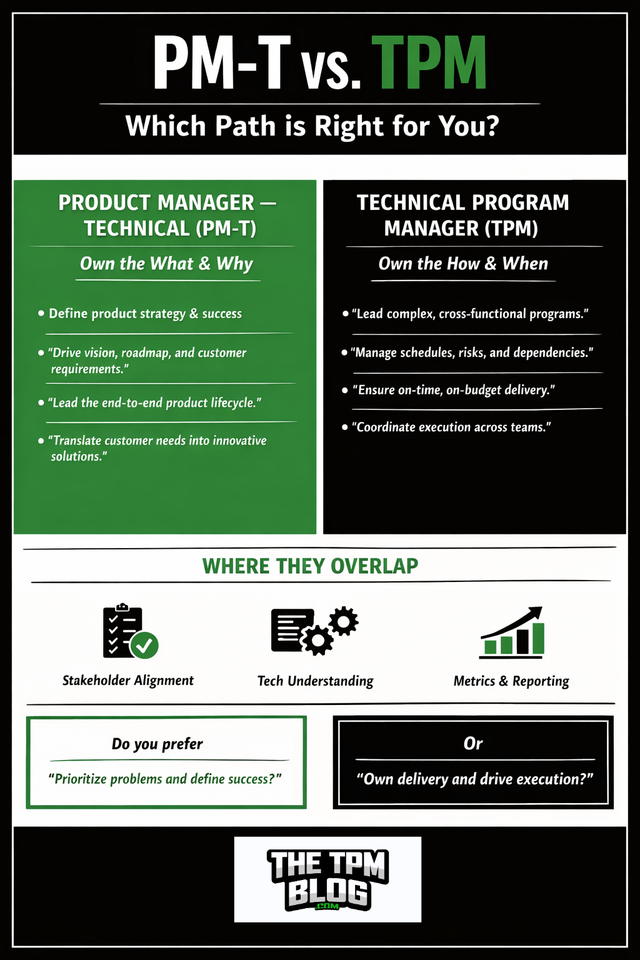
A Technical Program Manager (TPM) focuses on complex execution across engineering teams. While PM-T owns the “what and why,” TPM owns the “how and when.” Typical TPM job descriptions usually ask for:
“Lead complex, cross-functional technical programs.”
“Manage schedules, risks, dependencies, and stakeholder communication.”
“Drive alignment across engineering and partner teams.”
“Ensure on-time, high-quality delivery.”
The TPM role is delivery-centric. Success is measured by predictability, coordination, and risk mitigation.
Technical Product Manager vs Technical Program Manager: Key Differences
Accountability
PM-T:
- Owns product direction and measurable customer/business outcomes
- Defines success metrics and prioritizes features
- Makes tradeoffs based on value and impact
TPM:
- Owns program delivery and execution health
- Manages cross-team coordination and dependencies
- Mitigates risks and ensures predictable timelines
Technical Depth
PM-T:
- Understands APIs, high level architecture, UX
- Defines required latency, response times, etc. as user requirements
- Makes scope tradeoffs based on ROI of technical complexity/costs to feature value
TPM:
- Understands high level architecture, APIs, microservices, interaction between the different components, technologies used
- Knows the data flow, latency, reliability, bottlenecks, constraints of the design
- Influences choice of tech stack, design based on project and long term operational needs
- Can deep dive into the technical design when there are issues to advise on path forward
Core Metrics of Success
PM-T metrics:
- Adoption
- Revenue or business growth
- Engagement
- Performance improvements
TPM metrics:
- On-time delivery
- Risk reduction
- Cross-team execution quality / bugs
- Operational readiness
If your impact stories center on business results, you align more directly with PM-T. If your stories center on de-risking and delivering large initiatives, you align more directly with TPM. Both roles map to business impact, but the actions you take to deliver that impact will closely align with the specific core metrics that you are ultimately accountable for.
Where Technical Product Managers and TPMs Overlap
Despite the differences, there are meaningful overlaps:
- Strong written communication
- Cross-functional influence
- Technical credibility
- Stakeholder alignment
On platform or infrastructure teams, PM-T may define strategy and outcomes while TPM orchestrates execution across multiple engineering groups. The collaboration is tight, but accountability still remains distinct. In some companies, these roles also overlap with a senior engineering manager. The company’s organizational structure and team size are key factors in determining who does what. For example, in start-ups, a specific title might wear multiple hats because they cannot hire independent roles or hope to in the future, while someone else fills in.
How to Decide Which Career Path Is Right for You?
Both roles are high-impact. They simply optimize for different layers of the system. Do not assume one outranks the other.
Ask yourself these questions:
Do you prefer shaping product strategy, defining customer value, and owning business outcomes? If you enjoy asking “Should we build this?” → Product Manager, Technical.
Do you prefer driving large-scale execution, managing interdependencies, and ensuring delivery predictability? If you enjoy asking “How do we build this across five teams with high quality, with minimal risk?” → Technical Program Manager.
Related read: How to Become A Technical Program Manager in 2026
Technical Product Manager (PM-T) Title Variations
When searching for roles, don’t rely on titles alone. Variants include:
- Technical Product Manager
- Product Manager, Technical
- Platform Product Manager
- Product Manager, Infrastructure
- Data Platform Product Manager
- AI/ML Product Manager
- Developer Platform Product Manager
Some companies may omit “Technical” but expect deep technical fluency. If looking for roles, don’t limit yourself till you read the job description.
Technical Program Manager (TPM ) Title Variations
Common TPM title variants include:
- Technical Program Manager
- Program Manager, Technical
- Product Technical Program Manager (yes, it has happened)
- Infrastructure Program Manager
- Engineering Program Manager
- Release Program Manager
Always read responsibilities carefully. Titles might differ by company, but accountability in the job descriptions will usually be consistent.
Conclusion
If you want to own product vision, strategy, prioritization, and measurable business outcomes in technically complex environments, the Technical Product Manager path is the right target. Make sure you have the relevant experience where you can speak to those aspects. If this is a role you want to transition into, offer to take on some responsibilities for the product manager to start building this muscle. That is the only way to gain experience- by doing.
If you want to own delivery excellence across large, multi-team engineering initiatives, the Technical Program Manager path is a stronger fit. There is a significant growth potential in this role even in the IC track, and as a manager, similar to the product role growth path. Both converge in Director and higher roles, and require people management experience at that point.
The TPM101 course outlines roles and levels in the TPM career path along with the expectations of each level in terms of scope expansion. Knowing these distinctions before applying will sharpen your positioning, strengthen your interview stories, and help you pursue the role that fits with how you want to create impact. Check out ‘Ace the TPM interview’ course to kickstart your prep.
Ready to rock your TPM Interview?
A detailed interview prep guide with tips and strategies to land your dream job at FAANG companies.
Frequently Asked Questions: PM-T vs TPgM / TPM
What is the difference between a Technical Product Manager and a Technical Program Manager?
A Technical Product Manager owns product strategy, roadmap, and customer outcomes. A Technical Program Manager owns execution across teams, including timelines, risks, and delivery coordination. PM-T focuses on building the right product. TPM focuses on building the product right. Another little talked about distinction which is critical is that Product Managers do a lot of user, market and customer research which typically TPMs do not do.
What does a Technical Product Manager actually do?
A Technical Product Manager defines product vision, prioritizes features, sets success metrics, works with engineering on tradeoffs, and drives products from discovery to launch. The role combines product strategy with technical fluency.
Is a Technical Product Manager more senior than a TPM?
Not necessarily. They are different tracks. PM-T is measured on product impact and business outcomes. TPM is measured on execution excellence and cross-functional delivery. Seniority depends on scope, not title. These are two distinct job families. However, it is not always a step up as TPMs can be in a higher pay bracket than product managers depending on the company. The more technical companies tend to bias towards high salaried TPMs and PMTs, where they make almost the same salaries. So only choose this path if the work appeals to you more.
Do FAANG companies differentiate between PM-T and TPM?
Yes. In large tech companies, PM-T roles emphasize “define product strategy and roadmap” and “own business metrics,” while TPM roles emphasize “lead complex cross-functional programs” and “manage risks and dependencies.” The accountability layers are distinct.
Can a TPM transition into a Technical Product Manager role?
Yes, but the transition requires demonstrating ownership of product decisions, customer impact, and metrics. TPMs moving to PM-T must show they can define what to build, not just drive how it gets delivered. The product manager needs to be able to do independent research, survey the competition, identify market opportunities and unfulfilled customer needs. This is typically not the experience a TPM has and will have to work towards gaining to show the ability to perform well in a Technical Product Manager role. You will be competing with engineers, managers or business related jobs for this role as the transition path will be similar. Many product manager roles value an MBA or similar experience as it instills some of the foundational skills. The best way to transition is to closely shadow and assist a product manager in your company to start building some of the non-TPM skills required for the role.
Does a Product Manager-Technical earn more than a Technical Program Manager (TPM)?
Many technical companies have the same pay bracket for TPM and PMT roles, so do not expect a pay bump, but choose your role based on what you excel and enjoy doing. However, it doesn’t hurt to expand your skill set even without a role transition as the most senior TPMs usually have a strong business sense. In this age of AI, the barriers to entry to many roles are lowering.