Last updated on March 9th, 2026 at 04:51 am
After having hired and built large TPM teams where I have had to review several thousands of TPM resumes, here are my tips & checklists on what you need to keep in mind when writing and crafting a Technical Program Manager’s resume.
Your resume says a lot about you. The level of effort, tidiness, ability to crisply communicate, and understanding of the TPM role all come across on your resume. It’s imperative you spend enough time and effort to be your best. Instead of writing it as a record of work done, think of it from the lens of being a decision document for recruiters. Keep in mind the purpose your resume serves. Its primary goal is to communicate your experience and strengths to the recruiter and Hiring Manager (HM).
In today’s market, even strong TPMs don’t get interviews if their resume:
-
Doesn’t surface in ATS search
-
Doesn’t signal the right scope quickly
-
Isn’t aligned to the role they’re applying for
This guide is written for TPMs who are:
-
Preparing for interviews
-
Transitioning roles or domains
-
Re-entering the market after time away
-
Moving from execution-heavy roles into senior or principal scope
The goal is simple: get your resume seen, understood, and shortlisted.
One other key call out I would like to make is that once you have optimized your resume using the tips below and updated LinkedIn, you are going to get calls. Be prepared to start interviewing:) I have seen several instances where people are eager to get into the market and have worked weeks to get their resume done but have not yet started interview preparation. The preparation itself sometimes takes months. So do not prematurely apply for jobs before you are almost ready to interview.
TL;DR for Busy TPMs
-
Interview prep doesn’t matter if your resume isn’t seen
-
ATS systems filter before humans read
-
Most TPM resumes fail on clarity, not experience
-
Two pages is enough if every line earns its place
-
Keyword strategy + impact framing beats fancy formatting
The Hiring Manager’s Perspective
As you re-vamping your resume, it is important to consider the recruiter and the Hiring Manager’s perspectives. The primary question here is, does your resume reflect what they are looking for.
When creating your resume, it is important to understand that each hiring manager is looking for a specific set of skills. Reading the job descriptions should ideally give you some insights to what role you should be applying for. It is also important to mentally classify the different types of TPM opportunities and then assess if you are the right fit for them. Applying to the right opportunity is KEY and is as important as having the right resume. At large organizations like Amazon, Microsoft, and google, it’s important not to apply to every random opportunity but to be picky in what matches your skill set and resume.
Types of TPM Opportunities:-
- Hardware TPMs
- Eg: Alexa HW, Cruise HW, Microsoft HW (Surface)
- Infrastructure TPMs
- Eg: AWS, Azure, GCP, OCI
- Depth TPMs
- Embedded into the team
- InfoSec TPMs
- Eg: Governance, Risk, Compliance, Corporate Security, Product Security, Vulnerability Detection / Scanning, Data Security?
- Front End TPMs
- Eg: Primarily work with UX/UI, Android TPMs, and iOS TPMs.
- Back End TPMs
- Eg: Building Back end systems.
The above is to give you the sense to match the skills the hiring manager is looking for and for you to tailor your resume to fit the profile they are looking for. Ideally, you are not applying to roles to which you do have enough experience to hit the ground running.
From a resume screening perspective, we generally do not spend more than 30 to decide. Also, remember we are more interested in the last two 2 to 5 years of work you have done and care less about your entire work history.
Remember, at large organizations, most TPM openings have 100s of resumes that apply for opportunities. So a good resume is key to moving through the first stage of your interview.
Understanding The TPM Role
One key area most folks miss in both the resume and in their elevator pitch is understanding the TPM role itself. This might sound laughable, but if you are not from a product-based or a true tech environment it is hard to get a good grasp of the role itself. And if you do not understand the role, it’s harder to convince what recruiters and hiring managers are looking for on your resume.
Read
- How Big Tech Runs Tech Projects and the Curious Absence of Scrum
- Day in the Life of A TPM
- Technical Program Managers vs Product Managers vs Product Managers – Technical vs Engineering Managers
- Technical Program Manager Career Path
Listen
- Fireside Chat With Nacho Gomez & The TPMs At Amazon Madrid
- TPM Podcast with Ethan Evans
- Microsoft Program Manager Interview: With Alessandro Catorcini
- TPM 101
What Should a TPM Resume Showcase?
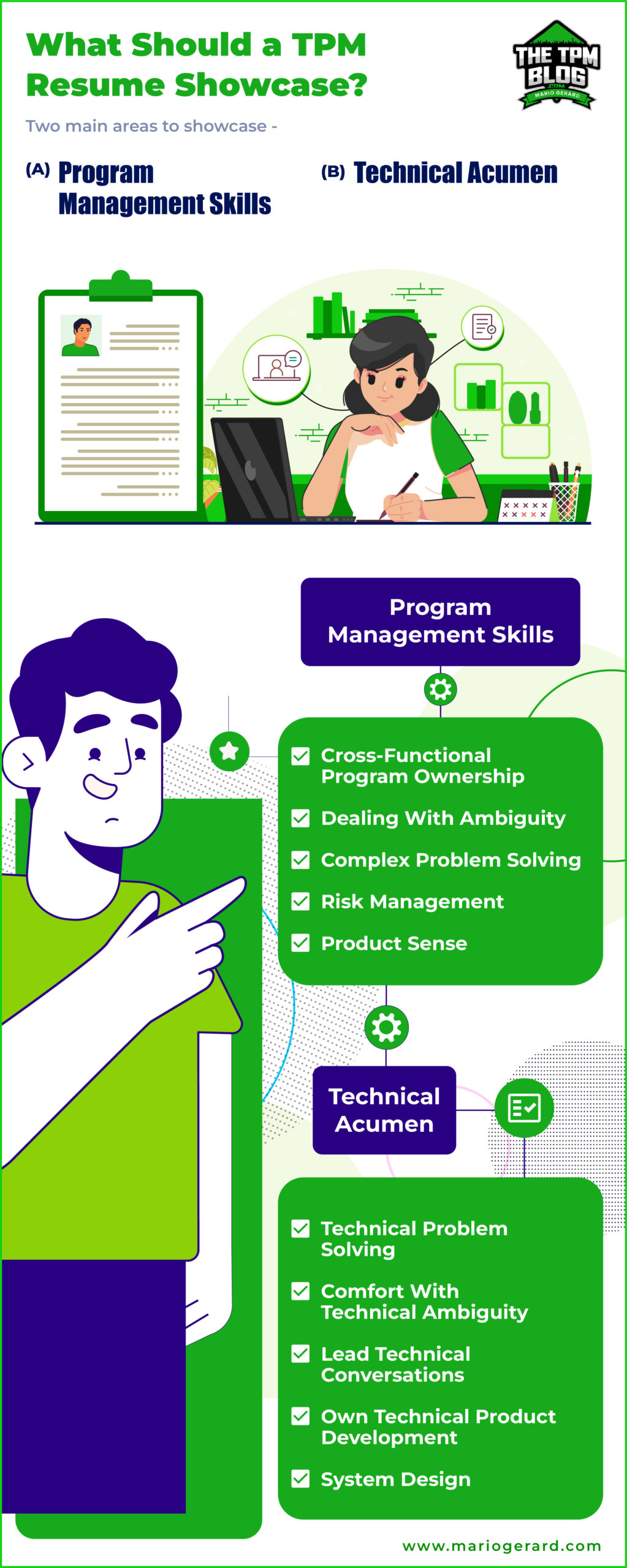
There are two main areas you need to showcase as you plan your TPM resume –
- Program Management Skills
- Technical Acumen
Let’s dive a little deeper into the two:-
Program & Product Management Skills On Your Resume
You ideally want to ensure you are calling out the skills you have experience in. Below I call out the variety of skills I would like to see in a TPM Resume. The need and the proficiency of product management skills would vary depending on the team/organization.
- Cross-Functional Program Ownership
- Dealing With Ambiguity
- Complex Problem Solving
- Risk Management
- Program / Project Management
- Product Sense
- Product Decesion Making
- Product Leadership
- ORK/KPI Driven Decision Making
- Influencing & Negotiating
- Interdisciplinary Program Management
- Define your role & the scope you are responsible for
- Communicate the IMPACT YOU and your program had
Technical Acumen
- Technical Problem solving
- Comfort with technical ambiguity
- Lead technical conversations
- Own technical Product development
- System Design
- Technical communication – Ability to articulate technical issues & technical constraints, etc.
- Modern Design Principles & Technologies
Use the above as a checklist. Does your resume have these attributes? Also, if you think I missed any, add it to the blog comments below 🙂
How Long Should a TPM Resume Be in 2026?
Two pages. Whether you have 2 years or 15+ years of experience, keep it short.
For mid-to-senior TPMs, two pages is the sweet spot:
-
Enough room to show scope and complexity
-
Short enough to be skimmed in under 30 seconds
-
Fully compatible with modern ATS systems
Anything longer usually signals lack of prioritization.
Tips to Shorten Your Resume to Two Pages
-
Cut early-career roles to 1–2 bullets
-
Remove duplicate bullets across roles
-
Combine similar initiatives into a single impact statement
-
If the bullet does not add anything new to the story which has already been told in your most recent 2 years of experience, question whether it is needed at all. Most hiring managers will skim through anything over 3 years old as they assume you got to current level by having all these skills. Only call out anything which was unique, different, or domain specific.
The TPM Resume Mindset Shift
Recruiters don’t read resumes line by line. They get 1000s daily for dozens of roles they are hiring for. They scan for signals and keywords.
Every line on your resume should answer at least one of these:
-
What did you drive?
-
Why did it matter?
-
How big or complex was it?
-
What does this say about how you operate?
If a bullet doesn’t provide a takeaway, it doesn’t belong.
2026 Tips to Optimize for ATS
File Format
-
Use .docx or text-based PDF
-
Avoid graphics, icons, columns, or tables
-
No headers or footers with critical information
Standard Section Headings
Use plain, predictable headings:
-
Summary
-
Experience
-
Skills
-
Education
-
Certifications
ATS systems parse these reliably.
Fonts and Layout
-
Simple fonts (Calibri, Arial, Helvetica)
-
Single column
-
Bullet points only
-
No charts or visual timelines
ATS accuracy matters more than aesthetics.
How to Beat ATS With the Right Keywords (Without Stuffing)
Step 1: Start With Job Descriptions
Pick 5–10 roles you actually want.
Extract recurring terms related to:
-
Domains (cloud, infra, AI/ML, security)
-
Tools (Jira, AWS, GCP, Kubernetes)
-
Responsibilities (risk management, dependencies, exec reporting)
These are your ATS keywords.
Step 2: Use Keyword Clusters
Organize keywords into clusters:
-
Technical: APIs, distributed systems, data pipelines
-
Program: milestones, risk, dependencies, delivery
-
Leadership: cross-functional alignment, exec communication
-
Tools: Jira, Confluence, GitHub
Use them naturally in bullets and summaries.
Step 3: Mirror the Job Description Language
If the role says “risk management,” don’t say “issue tracking.”
Semantic matches matter in 2026 ATS and AI screening tools.
Writing a Strong TPM Summary
Your summary should do four things:
-
Establish seniority
-
Define your domain
-
Highlight outcomes
-
Signal the roles you want next
Example: Senior Technical Program Manager with 10+ years leading large-scale platform and infrastructure programs. Proven track record delivering multi-team initiatives across cloud, data, and ML systems, driving cost reductions, reliability improvements, and predictable execution. Experienced partnering with engineering, product, and leadership to deliver complex programs at scale.
TPM Resume Checklist Continued 🙂
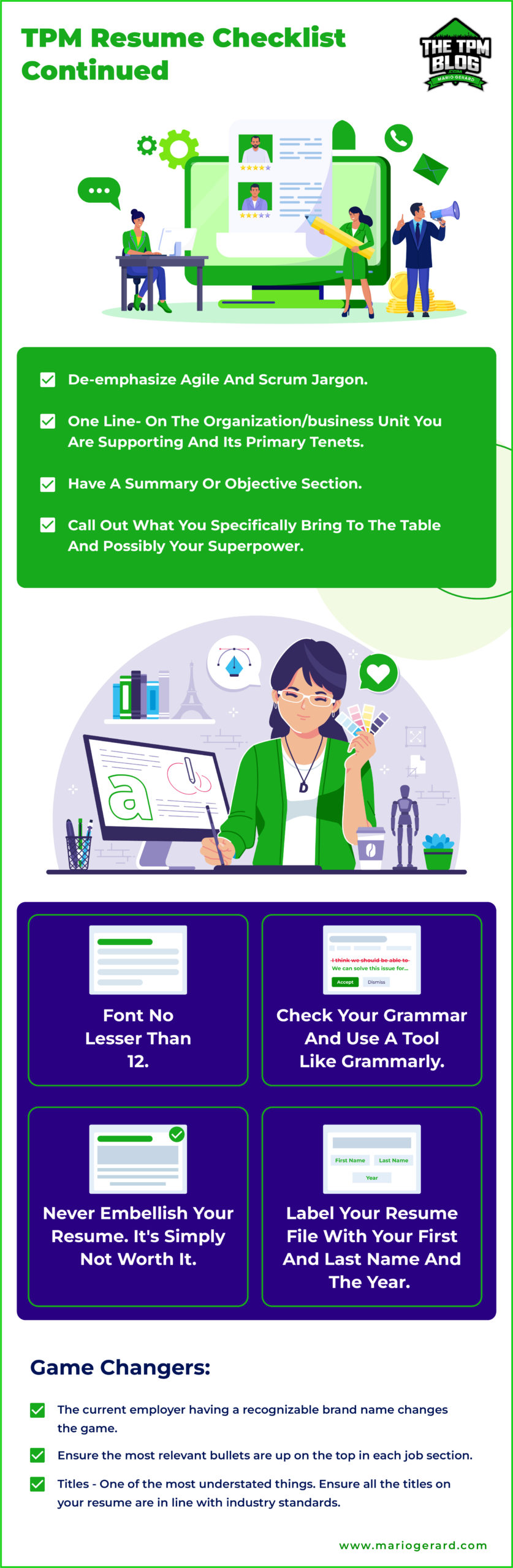
- Remove Agile and Scrum jargon. Its largely not used in tech.
- One line on the organization/business unit you are supporting and its primary tenets.
- You must have a summary or objective section where you call out what YOU specifically bring to the table and possibly your superpower.
- If you lack space, consider removing the Core Skills, Core Competencies, Career Highlights, Professional Summary, and About Me sections. It should all be in the main section which is usually named as one of these.
- Add your LinkedIn profile link. Make it clickable.
- If you have over 5 years of relevant experience, move the education and certifications to the end of the resume and skip anything from university to save space. It is not relevant to the level you will be applying at.
- Formatting: Tip – Keep it simple. Eg: Font no lesser than 12.
- Grammar – Check your grammar and use a tool like Grammarly.
- Never embellish your resume. It’s simply not worth it.
- Label your resume file with your frist and last name and the year.
- Utilize the space in your resume well. Do not have large blank spaces, etc.
- The more your experience the lesser number of bullets in each job/program.
- Game Changers:
– Having a well recognized brand name company will change the game. You can’t do much here – you are where you are. But its something to keep in mind while you look for your next gig as it will help you leapfron in your career.
– Ensure the most relevant bullets are up on the top in each job section. It’s likely only the top 2-3 bullets are going to be read for each role.
– Titles: One of the most understated things. Ensure all the titles on your resume are in line with industry standards. When we screen, we are ideally looking for people with a TPM title. IT Project Manager is passable, but we are definitely not looking for ScrumMasters. Yes, it’s a catch-22 situation. A short way to combat this is to try upping your responsibilities in your existing role.
Structuring Your Bullets In Your TPM Resume
As a TPM a large part of what you do is written communication. It is important to make the bullets on your resume concise and informative. Your resume is also your first piece of work people are going to read. So make it stand out. Here are some key pointers on what to include in while designing your bullets using the SMART methodology while keeping the bullet to 1-2 lines max.
- Specific:
- The programs that you owned and its objective.
- What were YOU responsible for.
- Measurable:
- What was the measurable impact in terms of OKR’s/KPIs or revenue?
- Call out specific numbers. (And be able to back them up when questioned)
- Action:
- What was the action you took?
- Did you bring cross-functional teams together?
- Did you build new org or launch a new program?
- What were the challenges?
- Relevance / Result:
- Where did this fit into the organizational priority?
- How important was this program?
- What was the final outcome?
- Did you make long-term process improvements?
- Did you change the way the org now operates?
- Timeframe:
- How long did it take?
- How many people/teams were involved?
To fit the above into one single-line bullet point. It takes work :).
The Resume Bullet Formula That Works
Use this structure consistently:
Action → Outcome → Scale → Signal
Example: Led dependency management across 4 product and 6 engineering teams, unblocking a delayed platform launch and delivering the program 2 quarters early for a 12K+ user system.
Signal inferred:
-
Cross-org influence
-
Complexity management
-
Ownership under pressure
The Most Common TPM Resume Failure
Listing responsibilities instead of outcomes.
Bad example: Owned roadmap execution and stakeholder alignment
Strong example: Led cross-org delivery of a cloud migration program across 6 teams, reducing infrastructure costs by 18% and improving deployment reliability to 99.9%
TPM Linkedin Checklist
A lot of people ignore the importance of LinkedIn. Every HM or Recruiter will look at it, and it is as important as your resume. If you have a well-optimized LinkedIn profile, you will get calls from recruiters. Set it up as open for work on LinkedIn Premium. You do not have to do anything fancy. Just make sure you check for the below :
- Ensure LinkedIn matches your work experience and dates on your resume
- Instead of copying the bullets from your resume, try to tell a story of what you accomplished its scope, and its impact on Linkedin.
- Creating project sections is a great idea, particularly if you have worked at one organization for a longer time.
- Is your profile link optimized
– https://www.linkedin.com/in/mariogerard/ vs https://www.linkedin.com/in/mario-83215116a/ - Do you have a good profile picture?
- Do you have LinkedIn premium turned on?
– Great for competitive analysis when you apply for jobs.
I have an Interview Prep Toolkit that covers resume writing, LinkedIn, ATS optimization and Interview Story Prep. Check it out.
Resume Checklist Before You Apply
Before sending your resume:
-
Upload it to an ATS checker
-
Compare it side-by-side with the Job Description
-
Ensure keywords appear in context
-
Read it out loud and ask “So what?” after each resume bullet
If the takeaway isn’t obvious, rewrite.
Action Words For Your Resume
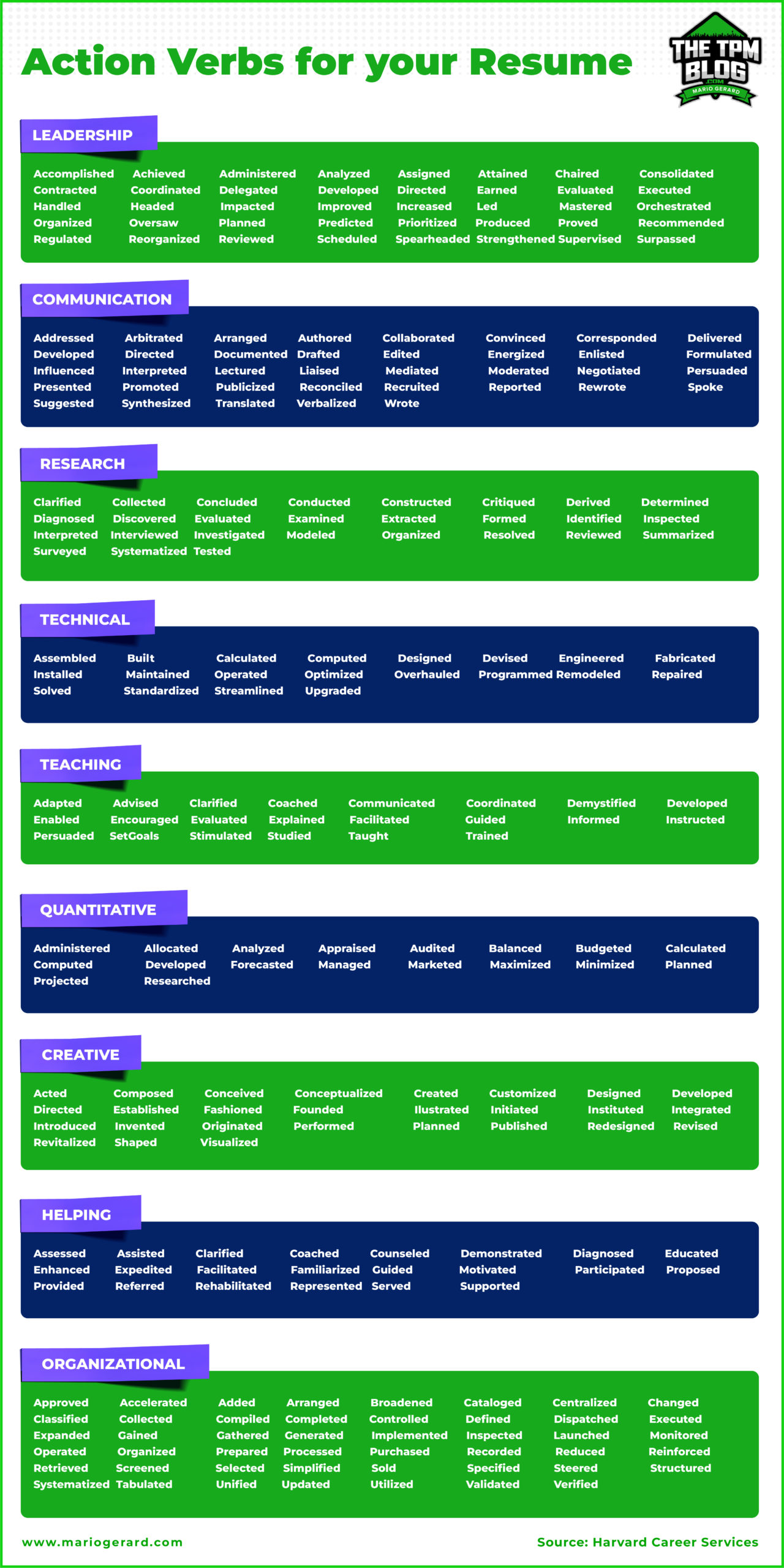
I have an Interview Prep Toolkit that covers resume writing, LinkedIn, ATS optimization and Interview Story Prep. Check it out.
What Is Your Competition Like?
Working at Boston Consulting, Oracle Cloud and Google taught me several things. One was, always to know your competition. From a resume perspective, you can see your potential competition here. Check it out and self-analyze where you would stand if you were the recruiter or hiring manager.
If you’re ready for interviews, transitions, or the next level, your resume needs to reflect that readiness clearly and quickly. This blog above is meant to help you do exactly that
Resume Resources For TPMs
If you are done with your resume and your LinkedIn profile and would like to have it reviewed by me, sign up here. I will review and mark up your resume and your LinkedIn and let you know the changes you would need to make. Also, if you are looking for better ways to frame the technical and the program management sections of your resume and want examples to check out the resume section of “Ace Your TPM Interview”.
Best of Luck !
Ready to rock your TPM Interview?
A detailed interview prep guide with tips and strategies to land your dream job at FAANG companies.
Frequently Asked Questions (FAQs)
What is the ideal TPM resume length in 2026?
Should I customize my resume for every TPM role?
Is PDF or Word better for ATS?
How many keywords are too many?
Do summaries really matter?
How do I show seniority without inflating titles?
What’s the biggest mistake TPMs make on resumes?
Your resume isn’t a checklist or a job description. It is an artifact that has to pass multiple filters and stand out. Your resume bullets need to show how you raised the bar not just did your everyday work.